
India has put on standby three ships and a maritime surveillance aircraft for assistance in the search operation after an AirAsia flight with 162 people on board on Sunday went missing en route from Indonesia to Singapore after losing contact with air traffic controllers.

The proposal was cleared by the Foreign Investment Promotion Board, Finance Ministry said in a statement.
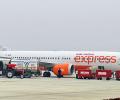
Discontent has been brewing among a section of the cabin crew at the low-cost carrier for some time now, especially after the start of the process of merger of AIX Connect, formerly AirAsia India, with itself.
The infusion will help the airlines plan their next rounds of operations as easing of 5/20 norms

The controversial 5/20 rule required an airline to have five years of domestic operations and 20 aircraft in its fleet to be able to fly abroad.
AirAsia recently said it would set up a 49:30:21 joint venture with the Tata Sons and Telestra Tradeplace of Indian investor Arun Bhatia to launch a new Indian airline.
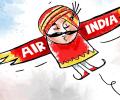
Air India will require more than 6,500 pilots to operate 470 aircraft that are to be supplied by Airbus and Boeing in the coming years, according to industry sources. Seeking to expand fleet as well as operations, the airline has placed orders for acquiring a total of 840 aircraft that includes an option to buy 370 planes. This is one of the largest aircraft order by any airline. Currently, Air India has around 1,600 pilots to operate its 113 aircraft fleet and in recent times, there have been instances of ultra-long haul flights getting cancelled or delayed due to shortage of crew.

The multinational search for the missing AirAsia flight entered the third day on Tuesday after a futile day-long scanning of the JavaSea where the Airbus 320-200 is believed to have gone down with 162 passengers and crew.

This is the third enforcement action against a Tata Group airline in over a month.

AirAsia is expanding its distribution network and increasing its offline travel partners.
An aviation website has evaluated AirAsia's potential network in India based on passenger market size, distance from Chennai and competition.
The airline's entry may trigger charges for every extra service such as baggage and seat selection.


Indian airlines will operate a total of 23,732 flights every week during the winter schedule, which is more than 8 per cent higher than the year-ago period, amid rising air traffic demand. The winter schedule 2023 -- effective from October 29 to March 30 next year -- for the scheduled carriers has been approved by aviation regulator DGCA. Go First, which stopped flying from May 3 and is undergoing an insolvency resolution process, will not be having any operations during the winter schedule.
Low-cost positioning is passe. Brand experts suggest ways in which the airline can differentiate itself in the minds of customers.

India is not an easy environment to operate in and grow because of the high cost of operations, says Neil Mills.
Low cost carrier AirAsia is likely to start operations in India by year-end.

On July 25 and 26, the regulator's team carried out the surveillance of Air India in the areas of internal audit, accident prevention work and availability of required technical manpower.

The hotel brand goes by the 'great value, great savings' tagline.

An AirAsia flight from Indonesia to Singapore with 162 people aboard reportedly went missing on Sunday morning after losing contact with air traffic controllers.
India's domestic air passenger traffic nearly doubled to 1.25 crore in January compared to 64.08 lakh recorded in the year-ago period, according to official data released on Monday. In January, IndiGo saw its domestic market share decline for the fifth consecutive month at 54.6 per cent. It carried 68.47 lakh passengers last month.

The reported buyback of Temasek's 20 per cent stake in Tata Play by Tata Sons will be the third instance of Tata Group providing an exit to a foreign partner in recent years. In 2018, Tata Sons paid $1.27 billion to DoCoMo to buy back 26 per cent of the group's telecommunication venture, Tata Teleservices. This was followed by Tata Sons acquiring AirAsia Berhad's 49 per cent stake in AirAsia India in two tranches to make it a wholly owned subsidiary.
Indian carriers transported 12.8 million domestic passengers in March 2023, a year-on-year growth of 21.41 per cent. India's largest carrier IndiGo shored up its domestic market share from 53.8 per cent in Q4 of FY22 to 55.7 per cent in Q4 of FY23, according to the Directorate General of Civil Aviation (DGCA) data released on Monday.

Budget airline AIX Connect has removed its manager from duty at Bengaluru airport following the incident of a flight taking off without Karnataka Governor Thaawarchand Gehlot last week, a source said on Monday.

Air India Express on Thursday cancelled 85 flights or around 23 per cent of the total daily capacity as the disruptions due to the cabin crew shortage continue and said Air India will operate services on 20 of its routes to minimise inconvenience to passengers.
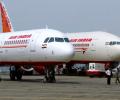
It offers a real opportunity for the flag carrier to compete on the world stage, backed by a leading conglomerate with deep pockets like the Tatas, observes Indrajit Gupta.

Due to the group's presence across multiple businesses, it is in a unique position in the aviation industry to bring the best of talents.

Domestic airlines flew 1.29 crore passengers in April, a rise of more than 22 per cent compared to the year-ago period, according to official data released on Friday. However, the domestic air traffic number last month at 128.88 lakh was marginally lower than the 128.93 lakh recorded in March. In April 2022, the number of passengers carried by airlines stood at 105.47 lakh.
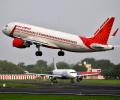
Tata Group-owned Air India, under its new chief executive officer and managing director Campbell Wilson, is optimising its domestic strategy under which the carrier is "densifying" its presence on metro-to-metro routes and exiting from unviable ones, Business Standard has learnt. Wilson took charge on July 25. Air India has increased its flights on metro-to-metro routes such as Delhi-Mumbai, Delhi-Bengaluru, Mumbai-Chennai, Mumbai-Bengaluru, and Hyderabad-Mumbai between June and November this year.

Air India on Monday announced a new compensation structure for its pilots and cabin crew, with a guaranteed flying allowance of 40 hours per month for both categories of staff. While the flying allowance has been doubled for pilots, it has been introduced for flight attendants as part of the new compensation structure. Pilots will earn an additional amount as a reward based on the number of years of service with the airline and get an allowance while undergoing training for command or conversion to another aircraft type.
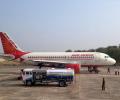
Management and leadership changes, in addition to synchronising operations between all its airlines, are showing visible results for Air India. Data from the Directorate General of Civil Aviation (DGCA) show that there has been a marked improvement in key operational parameters of Air India after the Tata group took complete control of the national airline in January. One of the most dramatic improvements has been noticed in Air India's passenger load factor (PLF) - a crucial metric of capacity utilisation of an airline's fleet that shows how many seats it has been able to fill on every flight.

An exclusive excerpt from The Tatas: How A Family Built A Business And A Nation.
Domestic air traffic rose 4.8 per cent on an annual basis to 126.48 lakh in February, while more than 1.55 lakh passengers were affected by flight delays during the same period, according to official data released on Friday. In February, Air India's market share rose to 12.8 per cent from 12.2 per cent while that of IndiGo marginally dipped to 60.1 per cent from 60.2 per cent in January. The domestic air traffic climbed to 126.48 lakh in February compared to 120.69 lakh in the year-ago period, the Directorate General of Civil Aviation (DGCA) said.

The AirAsia aircraft that went missing after taking off from Indonesia with 162 people on board may be at the bottom of the sea, a top Indonesian official said on Monday, as the multinational search for the Airbus continued amid fading hopes of finding any survivors.
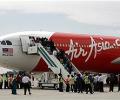
Fernandes said south India was a fantastic market and it would be the gateway for people who want to visit southeast Asia and beyond.
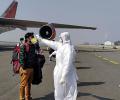
The load factor of six major domestic airlines--IndiGo, SpiceJet, Air India, GoAir, Vistara and AirAsia India -- stood between 70 per cent and 64.9 per cent in January.

Akasa Air's plane occupancy, or load factor, improved the most among all major carriers in April compared to the last month. Load factor signifies the percentage of seats that the airline has been able to fill in its planes. The Vinay Dube-led carrier, which started commercial flights in August last year, saw its load factor jump by more than 11 per cent in April, according to the Ministry of Civil Aviation's data
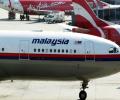
The 30-day visa-free entry is also currently enjoyed by eight ASEAN countries for the purpose of social visits, tourism and business.
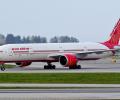
They say better late than never. For the Tatas, the original owners of Air India, bringing back the airline to its fold is worth the wait even if the attempt to privatise the bleeding national carrier by successive governments has taken over two decades. While many airlines have come and gone from the Indian skies since the time when the first move was made to privatise Air India to date, the salt-to-software conglomerate has never let the love affair with aviation, more so with Air India that its former chairman Jehangir Ratanji Dadabhoy Tata (JRD) had, to go off the radar. It is said that Tata group executives used to complain in private that JRD -- the pioneer of the Indian aviation industry -- spent more time worrying about Air India than the Tata group when he was heading both the entities.
Some airline sources, however, fear it will reduce overall yields
